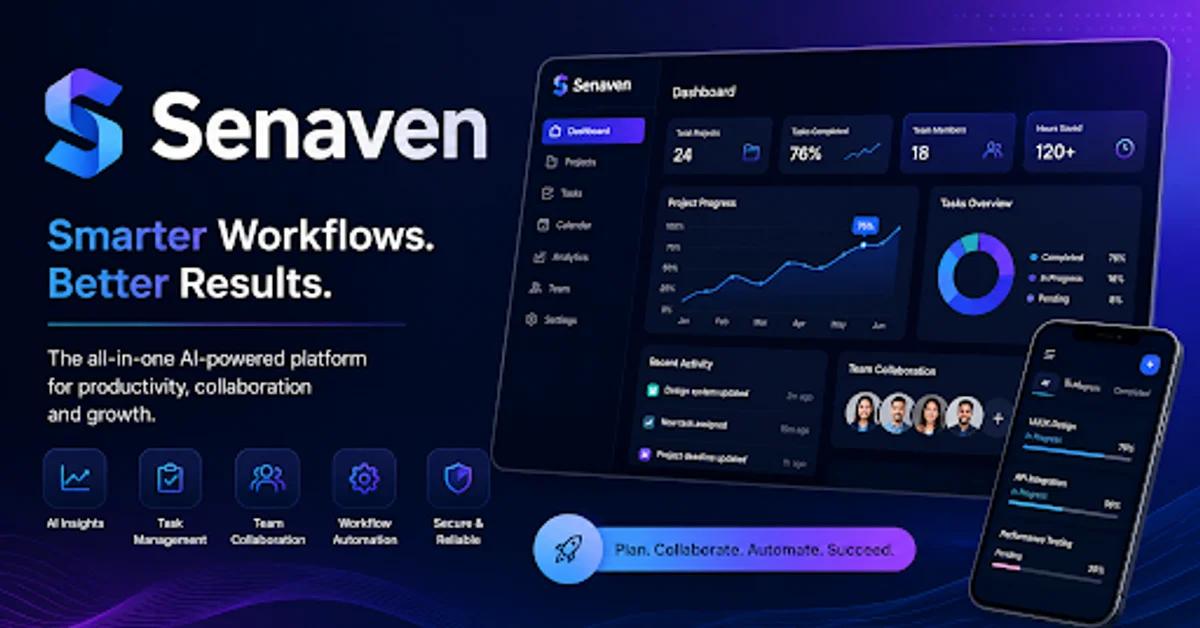
Senaven: AI Productivity Tool Overview
Senaven is presented as a modern productivity software solution designed to make work faster, clearer, and more organized. In simple terms, it is a Senaven platform built to support teams and individuals who want better control over tasks, data, and collaboration. It fits into the growing world of digital workflow optimization, where smart tools help people spend less time on manual steps and more time on real progress.
At its core, Senaven works like a flexible tool for planning, tracking, and improving daily operations. It combines the strengths of a task management system, a team collaboration platform, and an intelligent automation software approach. That makes it appealing for users who want one place to manage work instead of switching between many disconnected apps.
Senaven is gaining attention because modern teams need speed, clarity, and adaptability. Many businesses now rely on workflow automation, business process automation, and performance tracking systems to stay competitive. A platform like Senaven fits naturally into that need by promising simpler processes and smarter decision-making.
RELATED: Courseto: Master Skills with a Modern Learning Platform
How Senaven Works
Core technology behind Senaven
Senaven appears to rely on an artificial intelligence platform model supported by machine learning analytics and real-time data processing. This means the system is built to observe patterns, learn from usage, and improve recommendations over time. That kind of design is useful in tools that need to support digital transformation tools and smarter planning.
In practice, this type of system can help users organize tasks, monitor progress, and respond to changes with less friction. A well-designed productivity platform should not only store information but also help users understand it. Senaven’s approach suggests a combination of data visibility, intelligent suggestions, and automation that keeps work moving with less effort.
Workflow and automation system explained
A strong platform like Senaven usually begins with input from the user: tasks, notes, goals, schedules, or project data. From there, the system uses logic rules and automation to sort, prioritize, and display information in useful ways. This is where workflow optimization software becomes valuable, because it reduces repetitive effort and creates a cleaner process.
Senaven also seems to support adaptive workflows, which means the platform can adjust based on usage patterns. For example, a team may use it for approvals, task routing, reporting, or reminders. Over time, that creates a smoother operational efficiency tool that helps work feel less chaotic and more structured.
Key Features of Senaven
AI-powered analytics and insights
One of the strongest Senaven features is its focus on analytics. A modern productivity tool becomes much more useful when it does more than organize information. With AI-driven insights, users can identify delays, track output, and spot trends faster. That is where predictive analytics tools and performance tracking systems can add real value.
These insights are especially useful for teams that need to make better decisions quickly. Instead of relying only on manual review, Senaven’s data-driven approach can help leaders see what is working, what is not, and where attention is needed. That turns the platform into more than just a task list; it becomes a practical decision-support layer.
User-friendly dashboard and interface
A polished Senaven dashboard matters because the best tools feel simple from the first use. Users should be able to log in, view priorities, and understand their work without confusion. That is why a user-friendly dashboard and interface is such an important part of the platform’s appeal.
A good interface also supports adoption. People are more likely to use a system consistently when it feels intuitive. Senaven’s design direction, as described, suggests a platform that values clear navigation, clean layouts, and easy access to essential actions. That makes it friendlier for teams that want results without a steep learning curve.
Integration with third-party tools
Another major advantage is Senaven’s integration with other software. Modern teams rarely use just one app. They often work across Google Workspace, Zapier, Microsoft Power Automate, and other productivity systems. A platform that connects smoothly with these tools saves time and reduces duplication.
This is important because the best workflow automation tools are not isolated. They fit into a wider ecosystem of documents, communication, project tracking, and analytics. Senaven’s ability to connect with external tools makes it more practical for real-world use and more valuable for businesses that already depend on multiple digital systems.
Senaven Architecture and Technology
Cloud-based infrastructure
Senaven is described as a cloud-based software solution, which usually means users can access it from different devices and locations. Cloud architecture is a major strength for modern productivity platforms because it makes remote work easier, improves accessibility, and supports collaboration across teams.
For businesses, cloud systems also support scale. Teams can expand without needing heavy local installation or complex maintenance. That flexibility makes Senaven better suited for modern organizations that need simple access, secure storage, and smooth updates. It aligns well with the expectations of a current enterprise software tool.
Adaptive learning and smart algorithms
The idea of an adaptive learning system is central to Senaven’s value. Instead of staying static, the platform can improve through continued use. Smart algorithms can identify what users do often, what tasks repeat, and which processes can be simplified.
This matters because people want software that saves time, not software that creates more work. A system that learns from behavior can become more helpful over time. In that sense, Senaven behaves like a modern intelligent automation software product that grows with the user rather than staying fixed.
Benefits of Using Senaven
Improved productivity and efficiency
The biggest promise of Senaven is simple: better work with less friction. When a platform combines planning, automation, and visibility, it can improve productivity and efficiency across daily tasks. That makes Senaven appealing to individuals, small teams, and larger organizations alike.
Better productivity is not only about speed. It is also about clarity and consistency. A strong Senaven benefits list includes fewer missed tasks, less duplicate effort, and more control over priorities. That kind of improvement supports both personal output and team-wide momentum.
Better team collaboration
Senaven is also positioned as a strong team collaboration platform. That means users can share updates, coordinate tasks, and maintain visibility across projects. Collaboration becomes easier when everyone sees the same workflow and works from a shared structure.
This is especially useful for remote and hybrid teams. When communication is organized inside one platform, people waste less time searching for updates or waiting for answers. Senaven can support smoother teamwork by bringing people, tasks, and data together in one place.
Time-saving automation advantages
Automation is one of the most practical reasons to use a platform like Senaven. Repeating the same steps every day is exhausting and inefficient. With business process automation, many of those steps can be simplified or removed entirely.
That saves time and reduces errors. It can also help teams focus on higher-value work such as strategy, creativity, and customer support. Senaven’s value here is not just in doing work faster, but in helping users work smarter through thoughtful automation.
Senaven for Businesses and Teams
Use cases in project management
One of the clearest Senaven use cases is project management. Teams need a reliable way to assign tasks, track deadlines, monitor progress, and adjust priorities. Senaven can fit into that need as a central platform for organizing work.
For smaller teams, it can serve as a simple planning hub. For larger teams, it may help maintain structure across departments. In both cases, the platform’s role is the same: improve visibility and reduce confusion. That is the kind of support businesses look for in modern enterprise software tools.
Enterprise-level workflow optimization
At a broader level, Senaven can support enterprise-level workflow optimization. That means helping organizations improve how information moves, how tasks are assigned, and how results are measured. Better workflows usually lead to stronger execution and less waste.
This also ties into digital transformation tools. Businesses today want software that helps them modernize operations without making systems harder to manage. Senaven promises that it can support this shift through a mix of automation, analytics, and collaborative structure.
Real-World Applications of Senaven
Case studies and practical implementations
The description you shared suggests that Senaven may be useful across different environments, from startups to larger organizations. In a practical setting, a team could use it to manage projects, analyze progress, and reduce delays. That kind of implementation turns the platform into a real operational support tool.
A marketing team might use Senaven to coordinate campaigns. A support team could use it to track recurring issues. A leadership group might use the analytics layer to review performance trends. These practical applications show how a platform can move beyond theory and create everyday value.
Industry-specific use examples
Senaven can also be imagined across specific industries. In retail, it could help manage promotions and reporting. In education, it could assist with planning and communication. In professional services, it could support task coordination and client workflows. Each use case benefits from structure, visibility, and smart automation.
This versatility matters because modern productivity tools must work across many business models. Platforms like Notion, Asana, Trello, Monday.com, and ClickUp became popular partly because they adapted to many use cases. Senaven appears to follow that same direction by offering flexible workflow support.
Senaven vs Other Productivity Tools
Senaven vs Notion
When comparing Senaven vs Notion, the difference is likely in emphasis. Notion is often used as a flexible workspace for notes, databases, and documentation. Senaven, based on the description you provided, seems more focused on automation, analytics, and workflow optimization.
That means Senaven may appeal more to users who want active process support rather than a blank-canvas workspace. Notion is loved for flexibility, while Senaven appears to aim at structured productivity with smarter guidance. Both can be useful, but they serve slightly different work styles.
Senaven vs ClickUp and Asana
In a Senaven vs ClickUp and Asana comparison, the focus shifts to task management and team coordination. ClickUp and Asana are known for project organization, tracking, and team workflows. Senaven seems to position itself as a broader intelligent system with added AI-style insights and integration depth.
This makes Senaven interesting for users who want more than standard task boards. If it truly offers strong machine learning analytics, real-time data processing, and smart automation, it could stand out in a crowded field. That said, users often compare tools based on ease of use, onboarding, pricing, and integrations, so those factors matter too.
Challenges and Limitations of Senaven
Learning curve and adoption issues
Even the best platforms can have a learning curve. Senaven may feel powerful, but new users still need time to understand the dashboard, settings, and workflow structure. That is normal for any advanced productivity software or SaaS platform.
Adoption also depends on team habits. If people are used to tools like Google Workspace, Trello, or Monday.com, switching systems takes planning. The strongest products are not only capable; they are easy to embrace. Senaven’s success would depend on how smoothly users can get started and stay engaged.
Integration limitations
Another possible limitation is integration depth. Even if Senaven supports third-party tools, some organizations may need very specific connections or custom automations. That is common across the software world. No platform fits every workflow perfectly.
Users evaluating Senaven should consider how well it connects with their current stack, especially with tools like Zapier, Microsoft Power Automate, HubSpot, Tableau, and Power BI. Integration quality often determines whether a productivity platform feels seamless or fragmented.
Future of Senaven
AI evolution and upcoming features
The future of Senaven likely depends on how far its artificial intelligence platform can evolve. Users increasingly expect software to be predictive, responsive, and adaptive. That means future features could include deeper analytics, smarter task recommendations, and stronger automation.
As AI tools continue to improve, platforms like Senaven can become more helpful in daily planning and decision-making. If the product continues to grow, it may become a stronger example of adaptive learning system design in the productivity space.
Role in digital transformation
Senaven’s long-term value may come from its role in digital transformation tools. Businesses want systems that reduce manual effort, improve visibility, and support faster decisions. A platform that combines collaboration, workflow optimization, and data insights can become a real strategic asset.
That is why Senaven’s idea feels promising. It reflects the direction modern work is moving: lighter process overhead, smarter automation, and more connected teams. In that future, tools like Senaven can help businesses stay focused, agile, and ready for change.
RELATED: Yürkiyr: Meaning, Origin, and Why It’s Trending Online
Frequently Asked Questions
What is Senaven?
Senaven is a modern productivity platform designed to improve workflow automation, collaboration, and task management using smart digital tools.
How does Senaven work?
Senaven works by organizing tasks, analyzing data in real time, and using automation to simplify workflows and improve team efficiency.
What are the main features of Senaven?
Key features include AI-powered analytics, workflow automation, a user-friendly dashboard, and integration with third-party tools.
Who can use Senaven?
Senaven can be used by individuals, teams, and businesses looking to improve productivity, project management, and operational efficiency.
Does Senaven integrate with other tools?
Yes, Senaven is designed to integrate with popular platforms and tools to support seamless workflows and better productivity.
Summary
Senaven stands out as a fresh and ambitious concept in the world of business productivity solutions. It blends workflow automation, analytics, collaboration, and smart design into one idea. That combination makes it relevant for people who want more control, better speed, and cleaner workflows.
Its strongest appeal lies in simplicity with intelligence. A platform like Senaven can help users manage work without feeling overwhelmed. It can support teams, improve output, and create a smoother path toward better results. For anyone exploring modern productivity software, Senaven is a name worth watching.